
HK valves for a hydrogen compressor: 8,000+ hours without failure
The HK valve configuration supplied by RONDER for a new medium- to high-pressure hydrogen compressor project operated continuously for more than 8,000 hours without failure. To meet the second-stage valve’s reduced-leakage design requirement, RONDER selected a low-lift HK ring valve with a short total sealing length, performed valve-motion calculations, and prepared and checked the engineering drawings.
The second-stage valve shows how sealing, gas flow and valve-element motion were balanced for hydrogen.
Selecting the valve for the sealing requirement
Reducing hydrogen leakage was a design priority for the second-stage valve in this project. RONDER therefore selected the HK type for its short total sealing length and low lift, while checking both sealing when closed and flow capacity when open.
Total sealing length is the combined length of the sealing boundaries between the valve element and seat; it is distinct from sealing-face width.
A reciprocating compressor valve opens and closes in response to the pressure difference between the cylinder and the suction or discharge passage. When the moving element seats, it closes the flow path. The design therefore needs to address sealing and flow capacity together.
HK is a ring valve with wide passages, wide sealing surfaces, low lift and robust springs. The low lift reduces valve-element tilting and impact. See the HK valve page.
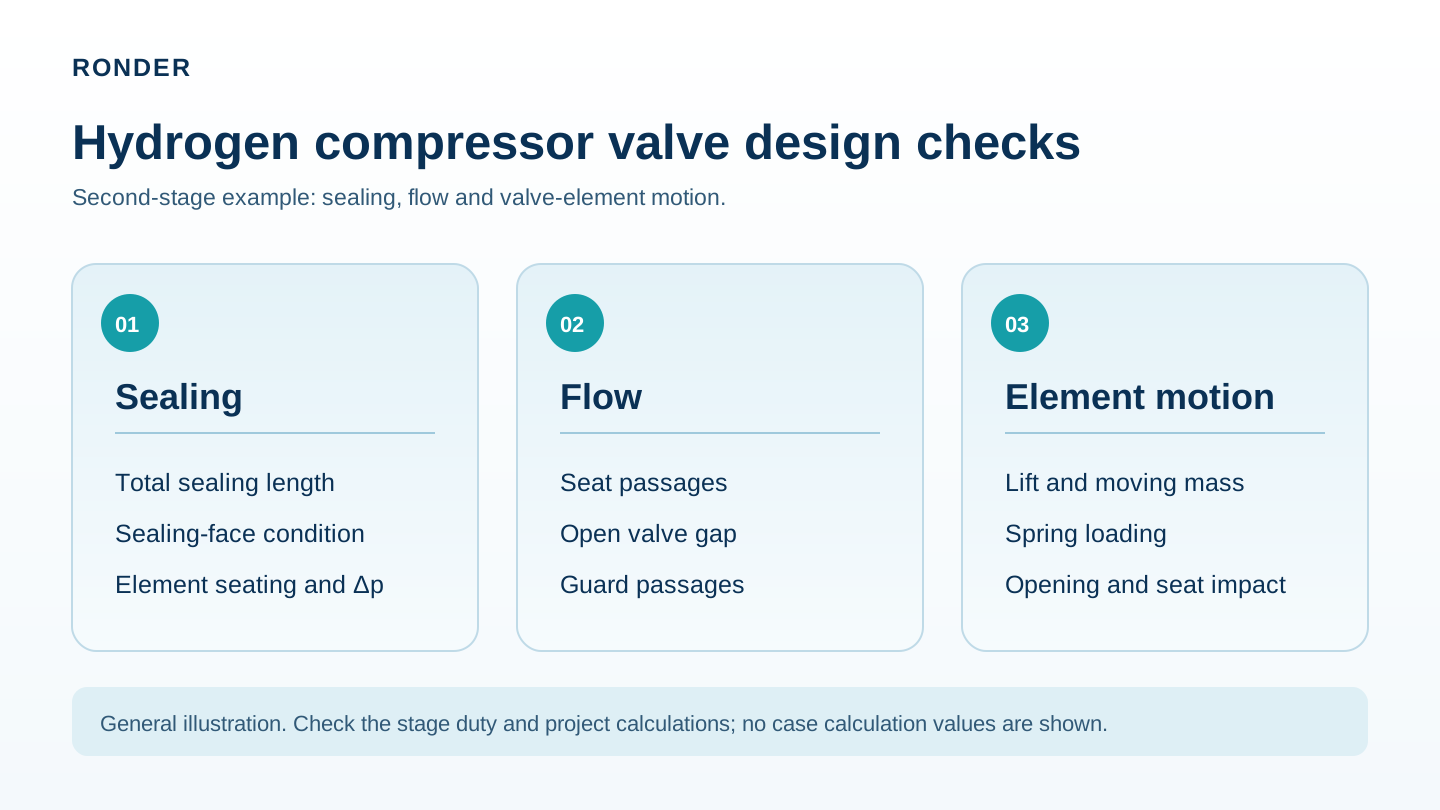
Sealing, gas flow and valve-element motion: the three design checks.
Balancing low lift with flow and motion
A shorter lift reduces the travel of the valve element, but also changes the flow area through the open valve gap. If that gap or another part of the flow path becomes restrictive, flow resistance may rise. The seat passages, open gap and valve guard passages therefore need to be assessed together.
Timely, stable closing also depends on moving mass, spring loading and gas forces. Lift, material and spring parameters must be matched to the duty. Higher impact velocity and operation away from the design point can affect valve-element life.
The customer specified 30Cr13 for the valve element.
Valve-motion calculations and drawing checks
After selecting the valve type, RONDER performed dynamic calculations for the second-stage valve, then prepared and checked the engineering drawings.
The dynamic calculation follows the valve element through opening, movement and closing in each cycle, looking at closing delay, rebound or flutter, impact velocity, and whether the flow passes at an acceptable pressure loss.
Drawing review translates the calculated design into parts and assembly details. The drawing check compares the installation interface, lift, sealing faces and spring arrangement with the calculation inputs.
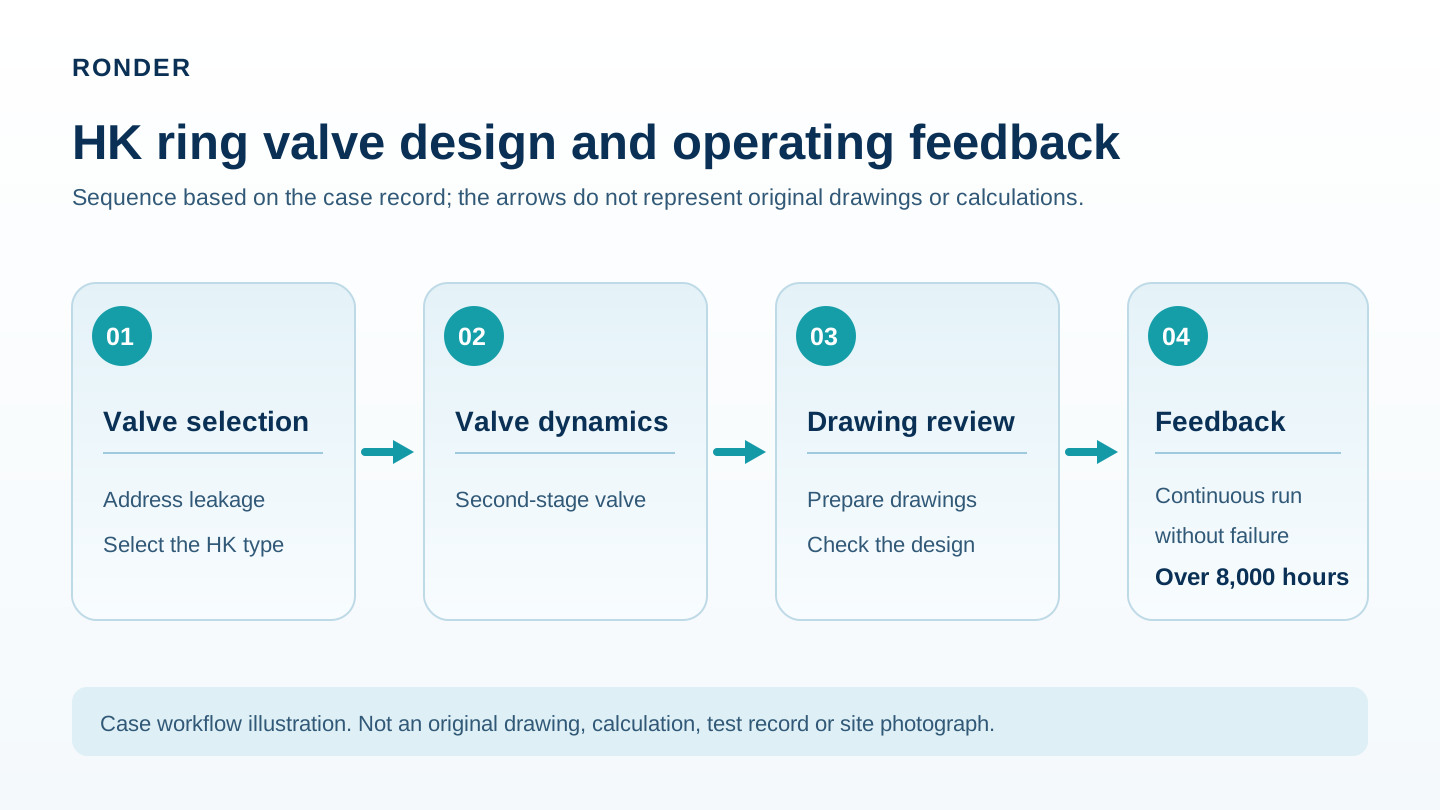
HK valve selection, second-stage dynamic calculation, drawing review and operating feedback.
Operating result
The HK valve configuration in this project operated continuously without failure for more than 8,000 hours.
For other gases, see RONDER’s WD valve case for a CO₂ compressor and WP valve case for a chloromethane compressor.
Enquire about a hydrogen compressor valve
For a new compressor package or an existing machine, send the available information to sales@ronder-valve.com:
- Company and contact details, and whether the enquiry concerns OEM supply or a replacement;
- Compressor model, stage, speed and any installation-interface information that can be shared;
- Gas composition, stage suction and discharge pressures and temperatures, flow rate and load range;
- Material and acceptance requirements. For an operating machine, include valve history, observed problems and photographs of failed parts where available.
State whether pressures are gauge or absolute, and give the flow units and reference conditions. If the full data set is not yet available, the compressor model, gas and main requirement are enough to start.
Further reading
- Claudio Vaglini, Compressor Valves, EFRC Training Workshop, 2015, sections on operating principle, valve dynamics, efficiency and reliability.
- Klaus Brun and Marybeth Nored, Valve Performance and Life of Reciprocating Compressors, Texas A&M University Turbomachinery Laboratories, 2012.
Related product
Related technical cases
- 1800 r/min Compressor OEM Valve Design | RONDER
- WG High-Pressure CO₂ Valves: 8,000+ Hours Without Failure | RONDER
View all technical resources and cases